US Open: The Official Tournament Guide
- CHARLIE RAY & CAROLINE DIDELOTThe US Open is a true representation of New York City, expensive and competitive. But, if you play the game smartly, you might enjoy yourself.
Increasingly, year over year, the US Open — specifically the USTA, which runs the tournament — has been coming under heat for several things: inflated prices, ticket scalpers, a surplus of influencers, etc. Some of these we as tennis spectators can find ways around, and some we can't. Most of these issues affect our experience as avid tennis fans, but at a major Grand Slam tournament like this, it's the perspective (and expectation) we bring into the US Open that can make or break our experience.
The US Open is the antithesis of Wimbledon. It's loud, chaotic, and, well, American. If you can remember that before you enter the grounds of the Billie Jean King Center, you might have a better shot at a good time.
Where To Stay
If you're coming in from out of town, it's best to try to stay near the transit you'll be taking to and from the US Open, since it's not recommended to go by car. We wouldn't otherwise recommend staying in midtown Manhattan, but to optimize for train lines and transit to Queens, these should do the trick:
How To Get There
To the US Open
To get to the US Open, we recommend taking the Long Island Rail Road (LIRR), since it can cut the time to get there by almost half compared to taking the 7 train. You can check train times using the TrainTime app (Penn Station → Mets-Willets Point).
You'll start at Moynihan Train Hall at Penn Station
Look for trains heading to Mets-Willets Point
Make sure to check the departures board in-person (not just the TrainTime app) — sometimes they add extra trains specifically to Mets-Willets Point for the US Open
Buy your one-way ticket at the kiosk; this way, you'll avoid extra fees
Find your train track, and you're off!
You won't need to show your train ticket until you arrive at the grounds, where you'll give it to the conductor
From the US Open
The 7 train is a better bet for leaving, since the LIRR runs on a set schedule that's tough to time out — whereas the 7 comes every few minutes. You'll head out of the US Open the same way you came in, but instead of going left, where you arrived using the LIRR, you'll head straight with the crowd.
You'll walk along a very long boardwalk until you see a sign for the 7 train. You'll take the lower entrance (heading downtown toward Manhattan).
There are about 19 stops between Mets-Willets Point and Hudson Yards. If you're staying in midtown, your best bet may be to get off at the Times Square–42nd St stop.
The Grounds
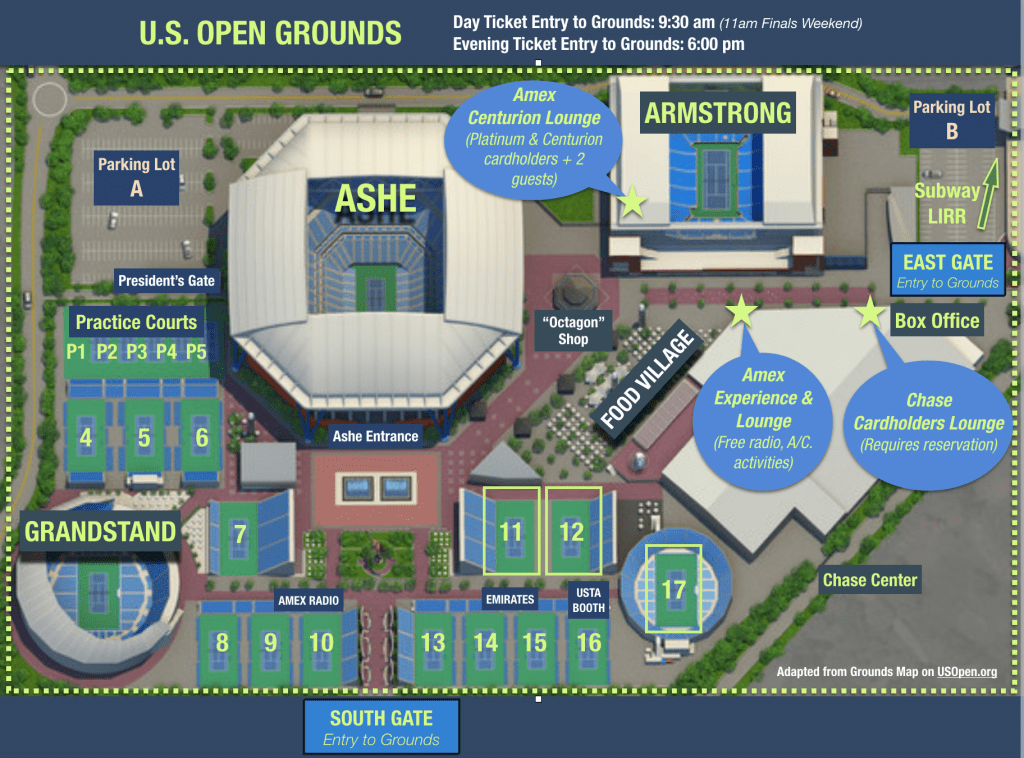
The US Open grounds are vast and without properly knowing them it’s easy to get lost. As we always say, try to arrive early to familiarize yourself with where everything is before catching practices, matches begin, etc.
Upon entering the grounds you’re greeted by Louis Armstrong Stadium (the second most major court) and then Arthur Ashe (the main court) with the “food village” complementing both of them like a triangle. From there you’re thrust into pretty much everything else –– shopping, outer courts, major brand activations, and the third major court, Grandstand, which is tucked away at the South West part of the campus.
The Stadiums
There are three major stadiums at the US Open with an unspoken fourth:
Arthur Ashe: this is the main stadium, the one everyone wants to be at, take pictures at, and the most expensive (more on that later)
Louis Armstrong: this is the second most important stadium at the US Open. The lower-bowl is ticketed, and the upper-bowl is general admission (GA)
Grandstand: this is the third most important stadium, with both ticketed and GA access
Court 17: the unspoken fourth court, and the one that doesn’t require a ticket, is Court 17. After Grandstand a lot of other great matches are put on this court. Just know, you will have to queue to get in, so if you have a match you want to see on this court, best to plan the day around it
For further explanation on the types of tickets at the US Open, check out the official descriptions here.
A Hot Take: How to Buy Tickets
Since going to the US Open can be incredibly expensive, Best of Ten recommends two ways to make the most of your money when buying tickets.
Fan Week
Capitalize on Fan Week. This is our second year taking the events during Fan Week seriously and purchasing tickets to them, and they have never disappointed. You're guaranteed top players at an accessible price point (under $50) on main courts like Arthur Ashe. Our two favorites, assuming they return, have been the Mixed Doubles Championship (originated in 2025) and Stars of the US Open (originated in 2026).
Louis Armstrong Stadium
You’ll come to find that early on Grounds Passes are the same price as what you’d pay for a seat on a ticketed court. They should be dynamically priced at $69, but when tickets are first released, it will be tough to find those prices. Unless you’re living in NYC and afford to buy last minute tickets, you’ll want to buy your tickets in advance. So how do you get the most value out of your purchase? If you read the ticket types, you’ll know that you’ll get more for your money if you buy a seat in a stadium. Most especially, if it rains, and it did a lot this year, you’ll be glad you did because Arthur Ashe and Louis Armstrong are the only courts with roofs when it rains.
Each year we have bought tickets like everyone else to Arthur Ashe. 2026 was our first year pivoting and buying tickets on Louis Armstrong instead, and we’re thrilled to be writing about this in our guide because it did not disappoint. When scheduling matches at the US Open, particularly in the first week, we’ve found that marquee names are put on Arthur Ashe stadium, but the compelling matches are placed on Louis Armstrong. We watched a 4+ Flavio Cobolli (2026 Roland Garros Finalist) match and it was some of the most exciting in-person tennis we’ve seen in a long time. This is, of course, because of how seeding works. Top 1-4 players will be placed on Armstrong but will not face other highly-ranked opponents in early rounds. Armstrong is where matchups from the Top 5-50 (particularly the tightest, buzziest matches) will get placed.
To that point, Louis Armonstrong also has a lot of pros for spectator stadium-specific experience:
“Semi-private concessions”: As we mentioned earlier, the upper bowl is GA and the lower-bowel is ticketed. There are also no suites on Louis Armonstrong, so only you and ~6,400 other people with ticketed seats, get access to the concessions. Shorter lines (especially for the bathroom), easier honey deuces, etc.
The stadium is also smaller which bodes well for spectators. You can be at the top of the lower bowl, waiting for a changeover to go down to your seat and still see the tennis perfectly.
As only one of two covered courts at the US Open, it can get very claustrophobic in these stadiums with little airflow and ventilation. Luckily, Louis Armstrong was built so that air pulls through the stadium –– specifically at the lower-bowl section –– which keeps cross ventilation moving and prevents it from becoming a “sealed box” (which is what happens with Arthur Ashe).
We paid $200 each for our tickets, and since it was raining that day, we spent the majority of our time making the most of our nice seats rather than moving around to the outer courts, which had no matches on them due to rain. Best of Ten typically loves going to watch matches on the outer courts, but the queues aren't like the ones at 1,000-level tournaments and can be very long. So unless there's a match you're dying to see, you may spend the majority of your day just trying to get into a non-ticketed court.
Tournament Experience
Etiquette
This was the big topic of the 2026 US Open. Blame the influencers, blame the brands who invite them, or Susan to my right who was talking on her phone for the majority of a 4+ hour match –– yes, wild behavior! The tennis etiquette in New York is poor, at best. Unfortunately, the ushers don’t help much. Most ushers will let you go to your seat while players are actively playing, and not during a changeover. Here is how to be part of the solution, not the problem:
Silence during points. If the players are actively playing, don’t chat with your friends, make loud noises, etc. Once a point is over you can make noise.
Timed cheering: applaud or cheer only after a point or rally has been completed. This can be hard to do if a point is really exciting, but it’s distracting to the players. This goes for making noise while they are serving too.
No flash photography. This is something Coco Gauff brought up specifically. Not much distracts her while playing tennis, but flash photography is hard to ignore.
Do not get up, go to your seat, or move, until there is a changeover. A changeover is the 90-second break players get between games and sets. They will go over to their benches, sit down, drink water, and take a load off. That is when you can move around.
Food & Beverage
If you haven’t heard of the Honey Deuce, you’ve been living under a rock. The Honey Deuce might just be the most iconically US Open image worldwide. Grey Goose, lemonade, raspberry liqueur, three melon balls scooped to look like tennis balls, served in a cup (that you keep!). Its $23 price tag has raised frustration from fans, which is something that has always puzzled us… any cocktail in New York city is going to be at least $16-18. This one comes with a commemorative plastic cup? Don’t tell the tournament, but $23 almost feels cheap…
Recently, the tournament has started selling a frozen Honey Deuce, which is great. Definitely worth a try if you haven’t had one before, particularly if you’re there on a hot day.
Don’t be afraid to look past the Honey Deuce. The Grey Goose bars also have a more extensive cocktail menu with drinks like the First Serve -- and they are each $20. It’s fun to drink through their menu and find something you like that’s a bit more off the beaten path.
Now, for food. Yes, we got Salt Hank's French dip this year. How could you not? The line for their brick-and-mortar store in Manhattan starts at 10am and is routinely sold out by the time you make it to the front. At the US Open you do have to queue -- but if you’re smart about avoiding mass exodus times from Ashe and Armstrong matches, you won’t spend more than ten minutes in line. It is $38, which is steep for a sandwich, but on a hot day you'll only want half of it anyway. Split it with whoever you're with and get something else with the other ten bucks.
Beyond that, the US Open food village is just plain good. Real chefs, New York institutions, tons of variety… these food stalls are serious culinary operations, not just stadium concessions with a logo slapped on. Worth perusing at the top of the day, making a plan, and buying/eating intentionally beyond grabbing what’s close.
An extra note: many will mention the Coqodaq chicken nuggets with caviar and other Coqodaq items. While we love the restaurant, we find the tournament catering to be underwhelming!
Brand Activations
If you have a Chase or Amex card, use them for free perks! Both have dedicated lounges on the grounds, air conditioning, seating, chargers, and free bites, which sounds negligible until you're seven hours into a humid day and just want to sit somewhere that isn't a plastic chair in direct sun. Chase Lounge is first-come during Fan Week, then reservations-only once the main draw starts, released daily at 9am on their site -- book it the night before or you'll miss the window. Amex runs two areas: the general Card Member Lounge for anyone with an Amex, and the Centurion Lounge for Platinum/Centurion holders via Resy.
Beyond the card perks, there's a decent amount of free stuff scattered around if you know to look for it. La Roche-Posay runs an SPF sampling booth (useful, actually, because you will get burned if you're out there all day and forget). Heineken's doing a promo letting fans swap old US Open ticket stubs for perks. Chase has charging stations all over the grounds, free to use whether or not you're a customer.
If you're around Hudson Yards before or during the tournament, there's also a free week-long fan activation at the Main Plaza -- mini tennis courts, a gaming area, photo ops, and a Grey Goose Honey Deuce stand -- worth a stop if you're killing time in the city away from the grounds.
Tips and Tricks
Weather
We’ve found that the weather at the US Open gets increasingly worse year-over-year. Probably due to global warming, but here is the latest:
In 2026, the US Open suffered many days of rain coupled with high humidity. It was muggy and felt like New York City was suddenly a tropical destination where you don’t even bother blow drying your hair because it will just frizz. To make matters worse, once you get inside the covered stadiums, the airflow is poor and the humidity gets trapped inside a big dome with you and 23,000 other people.
Always check the weather, but expect rain and highs of 70s and 80s. Most importantly, prepare for the rain and the heat. We were smart and brought an umbrella on day one, but by day two we didn’t want to lug it around. Big mistake, because the only umbrellas you’ll find at the US Open cost $76, and that’s before tax.
Worn
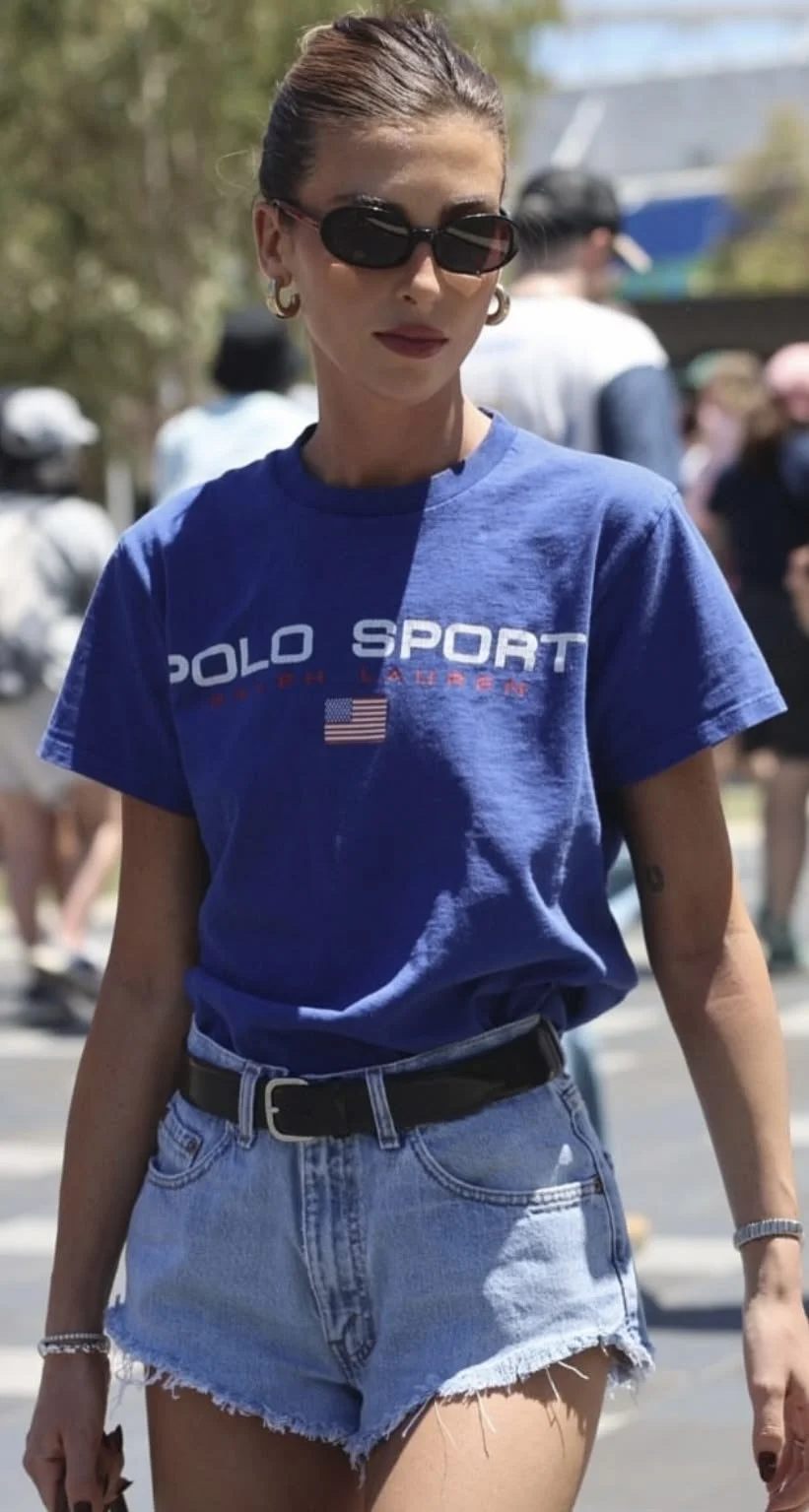
This year, pants, shorts, or anything you’d be ok sitting in plastic chairs in or getting caught in the rain was high on the list of consideration. Had I been smarter, I would have worn short sleeves, but there is always something to learn.
Witnessed
We’ve really seen it all. Similar to NYC, everyone dresses in their own unique style so as far as “fitting in” there is really no such thing.
Would Recommend
Based on the weather from this year, we’d recommend function and form over formality. A few considerations:
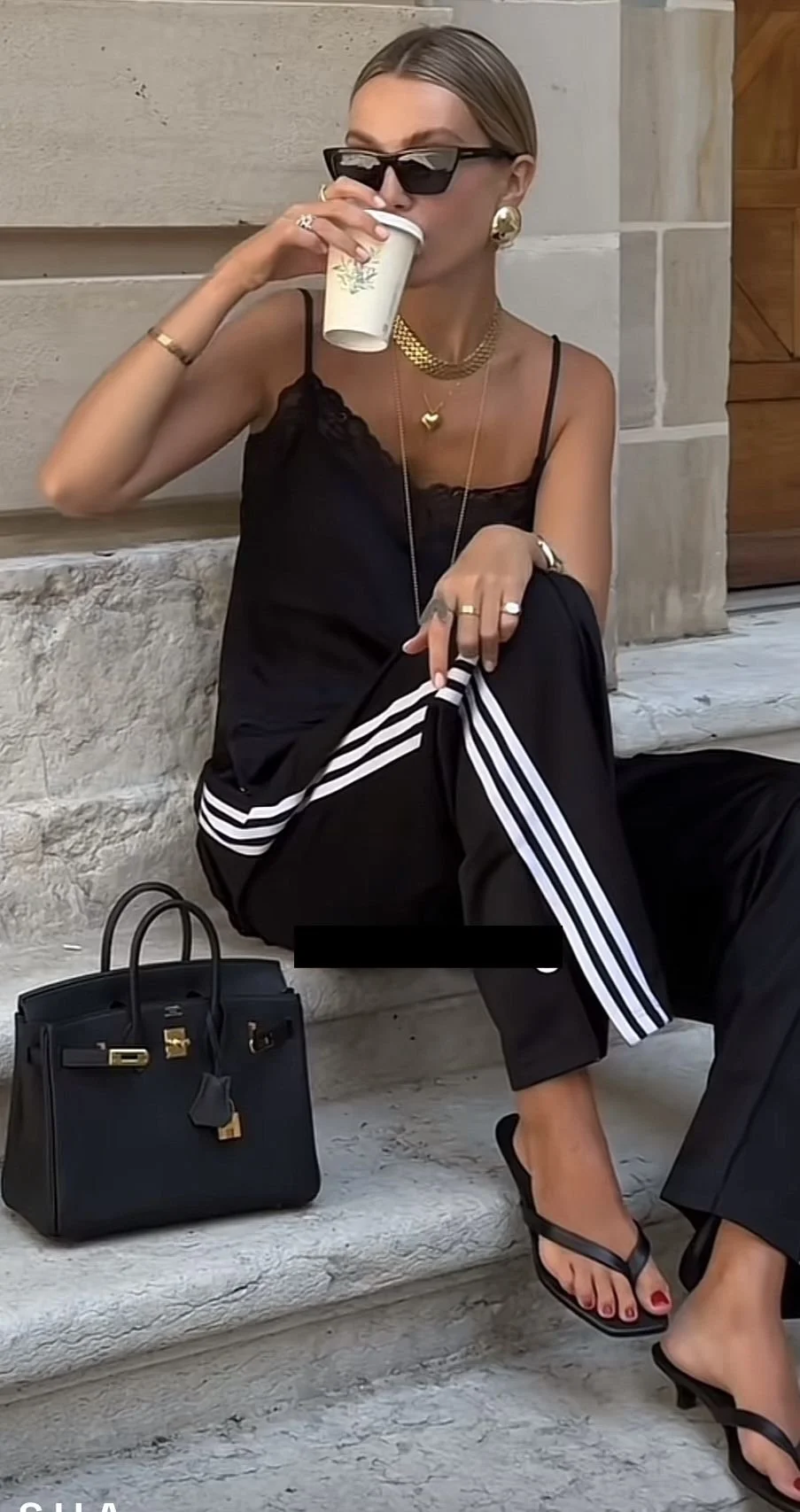
Closed toe, flat shoes. It’s easy to get caught in the trap of seeing all these kitten heels and heeled sandals at the US Open. Don’t fall for it. You will be doing lots of walks, especially if you’re taking the train. It’s New York City afterall!
Sporty chic is a great vibe to go for. It’s a way to look cute, lean into the “casual” NYC vibe that makes the US Open unique, and be comfortable. Adidas is a great brand to look at for this!
Try to wear short sleeves, if you can. Like we were saying earlier it can get muggy so short sleeves or layers are a great idea!

What to Bring
American tournaments are notorious for bag policies. Luckily the US Open’s isn’t that bad: Each guest is allowed to bring one bag into the US Open, and it must not be larger than 12” W x 12” H x 16” L.
A pro tip here: if you plan on knocking back tons of Honey Deuces and want to keep the cups, put a foldable tote bag in your main bag as you’re coming into the stadium. You’ll have a separate bag for those sticky, plastic glasses as you rack up Honey Deuce after Honey Deuce.
Lastly, you can bring an umbrella into the grounds. Capitalize on this if there is even a CHANCE it may rain that day! Bring an umbrella or pay $76 for one at the gift shop.
Final Verdict
It's easy to hate on the US Open. It's now mostly a whisper of a tennis tournament with a foundational see-and-be-seen platform for sub-35 NYC transplants laid overtop. It's easy to get bitter about that. With time, we've chosen to soften our point of view.
What NFL fan spends their life hating on the Super Bowl? What fan of anything dedicates their time to tearing down the most visible moment for their sport, worldwide, every year?
If you can set that feeling down for a second, what's actually happening at the US Open is a million-plus people showing up for tennis. Some of them are there for the melon balls and the outfits, sure. But plenty of them are watching a match for the first time, or bringing a kid who's about to fall in love with the sport, or seeing a player they've only watched on a screen. That's not nothing. That's the sport growing, even if it's growing in a form we don't always recognize.
It would be selfish to want that gate kept shut. Selfish to keep tennis for the people who already know how to watch it right, already know not to talk during a rally. More noble, indeed, to spread the wealth! Spread the love of the sport, imperfect crowd etiquette, and $23 cocktails, and let the rest sort itself out over time.
Arthur Ashe himself put it better than we can:
"From what we get you can make a living; however what we give can make a life.”
Take what you get out of a day at the US Open and let it be worth something beyond you, too. Bring someone who's never seen tennis live. Point a first-timer toward Court 17 when a great match is happening there instead of guarding it like a secret. The tournament is only as good as what we're willing to give back to it.