Madrid Open: The Official Tournament Guide
- CHARLIE RAY & CAROLINE DIDELOTWhen traveling to Europe, the best advice for Americans is to quickly reject the expectation that anything across the Atlantic will be like it is stateside. Luckily for tennis fans, our first European tournament was different in all the best ways. Within minutes of arriving, the Madrid Open quickly rose to the top of Best of Ten’s list for best tournament (so far) -- but because it masters culture and authenticity in a way European sporting events often do best. It feels less manufactured, less over-programmed, and far more confident in simply letting the tennis carry the experience.
The Background
The Madrid Open occupies a particularly interesting spot on the tennis calendar, serving as the first combined ATP/WTA clay event of the European swing. While the men have already played Monte Carlo and the women begin earlier on green clay in Charleston, Madrid is the first real temperature check for the full clay season.
Some tennis fans like to dunk on Madrid. In 2026 especially, several top players skipped the tournament due to injury concerns or to recover ahead of French Open. In many ways, Madrid is the “Miami” of the clay swing: big, flashy, commercially important, and occasionally accused of not being “real” enough by purists.
From a playing-conditions standpoint, Madrid is probably the biggest outlier of the clay season (and certainly of the “Terra Cotta Triple,” a term proudly coined by Best of Ten). The altitude causes the ball to fly noticeably faster than in Rome, while the clay itself can become surprisingly slick and low-bouncing in the heat.
And finally: if you’ve never seen photos of Madrid’s brief blue clay era, please do yourself the favor of looking it up. We’re thrilled to report that experiment lasted just one year, though it remains permanently etched into the tournament’s lore.
Planning Your Trip
Caroline and I used the Madrid Open as justification for a larger trip through Spain, where we spent time in Madrid, Barcelona, Cadaqués, and Priorat.
One of the best parts about planning around this tournament is that Spain is incredibly well connected by train, making it very easy to tack another city (or three) onto your trip.
To the extent you’re able, we’d absolutely recommend doing that. But it’s also worth saying: Madrid more than holds its own as a standalone destination. By the end of the trip, it had become one of our favorite cities in the world.
Where to Stay
The good news about Madrid is that, much like Spain itself, it’s extremely well connected. The Metro is excellent, the city is easy to navigate, and despite being a major European capital, Madrid never feels overwhelmingly large or difficult to move through. You can realistically stay in most neighborhoods and still have a relatively painless tournament experience.
We stayed in Cortes, which worked especially well because it sits slightly south-central within the city, putting us a bit closer to the Caja Mágica (located in San Fermín). Over the course of the trip, though, we spent time all over Madrid — near Retiro, Salamanca, Chamberí, and beyond — and genuinely struggled to find an area we didn’t like.
At one point in Cortes, we also had a literal shoulder-to-shoulder encounter with Jasmine Paolini, so stay alert.
The city is beautiful, clean, and constantly active without feeling chaotic. It’s the kind of place where you accidentally walk for six hours.
What to Do
Check out the map below (or HERE) for a full list of places we visited and would recommend. Please excuse some of Caroline’s shopping mixed in.
If we had to narrow it down, we wouldn’t skip the following:
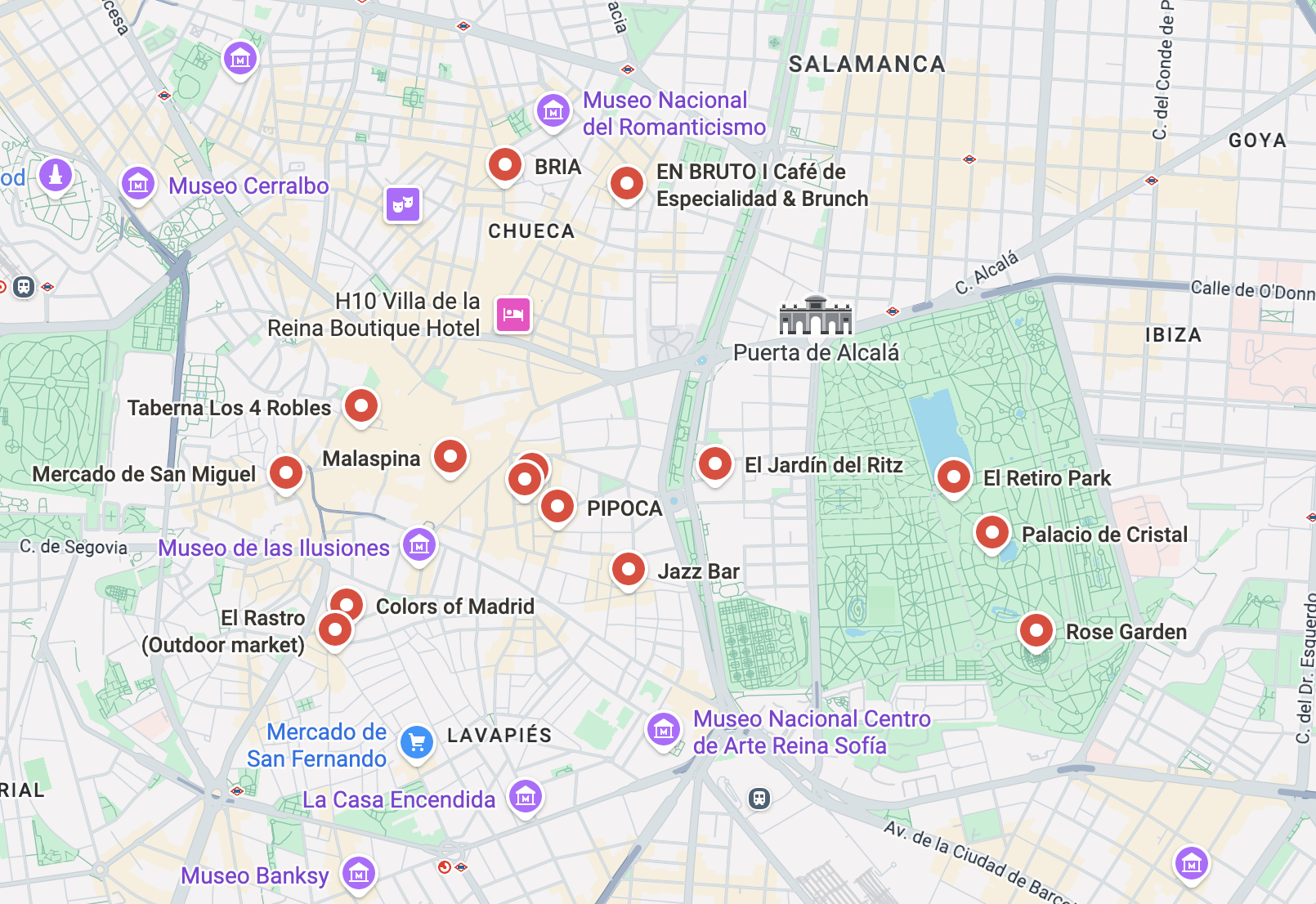
Mercado de San Miguel for a quick €1 croqueta and a chaotic-but-fun food hall experience
Taberna Malaspina for a classic Madrid tapas experience
En Bruto for excellent coffee, brunch, or really any meal — plus a good excuse to explore another part of the city
Chocolatería San Ginés for the most classic churros in town
El Retiro Park, which somehow still exceeded expectations despite everyone telling us to go
As you eat your way through Spain, make sure you become properly acquainted with Pan con tomate, Croquetas, Gambas al ajillo, Jamón ibérico, tinto de verano, and vermouth. Preferably all in one sitting so you can do it again the next day.
Getting Around the Grounds
Getting There
While it’s possible to take public transit to the Caja Mágica (and we are famously supporters of doing so), rideshare is generally anywhere from 15–30 minutes faster depending on where you’re staying.
When arriving at the venue — and more importantly when leaving — set your rideshare pickup/dropoff to the street entrance where the app naturally defaults. The walk to the stadium is extremely short, and after sessions you likely won’t be able to get a car any closer anyway.
The Complex
Caja Mágica is one of the best-designed tennis facilities we’ve visited.
Three major courts are wrapped around a breezy, air-conditioned central concourse filled with food vendors, media areas, and gathering spaces. At court level, there’s a beautiful lower concourse packed with retail activations: champagne bars, fresh oysters, the first-ever official ATP store, and more.
Gates open roughly one hour before play, though the tournament does a strangely poor job communicating this. Staff will often encourage you to arrive closer to match time. Ignore them. Arriving early gives you the rare opportunity to experience the grounds while they’re still quiet and uncrowded.
The Courts
There are two primary stadiums at the Madrid Open: Manolo Santana Stadium (the marquee court) and Arantxa Sánchez Stadium (which often ends up hosting equally compelling tennis).
Manolo Santana Stadium
Our favorite places to watch from are the corners or the ends behind the players, where the pace and movement of the match simply feel more real.
For daytime sessions, Sections 01–04 and 13–17 (both upper and lower bowls) are generally safest for shade. If your budget allows, we strongly recommend the lower bowl (Section B). The proximity to players dramatically changes the experience and is absolutely worth it.
Arantxa Sánchez Stadium
When buying tickets here, note that the lower sections (A13–A16) receive direct sun during daytime sessions. The upper bowl through roughly Row 5 is generally much safer if shade matters to you.
Practice Courts
The practice courts are tucked beneath the main level, almost hidden behind the activations and lower concourse. Accessing them feels a bit like discovering an underground tennis world.
Most practice courts have two viewing sides, and crowd distribution between them can vary dramatically. If the primary side looks packed, don’t be afraid to walk along the moat pathway to access seating from the opposite side.
Also note that after Court 14, the remaining practice courts are inaccessible to the public, even if they still appear on tournament maps or schedules.
The Experience
The Madrid Open was the most “zen” we’ve ever felt at a tournament.
The grounds are simply well run in a way you notice immediately but struggle to fully articulate. Crowd density is controlled without feeling restrictive, movement around the site is smooth, and there’s a general sense that the tournament was actually designed to accommodate the number of people attending it.
Even during peak hours, things rarely feel chaotic.
The bathrooms were also genuinely clean, and Caroline never waited in a single line. Ladies: this is not normal tournament behavior. There are restrooms everywhere, which turns out to be one of the greatest luxuries in professional tennis spectating.
Buying Tickets
A lot of top players request day sessions and actually get them — particularly top seeds, returning champions, and players the tournament is especially invested in protecting.
This matters because the conditions in Madrid change dramatically throughout the day.
In direct heat, the clay becomes drier, faster, lower bouncing, and often much slipperier. Flavio Cobolli even compared it mid-match to an ice rink, which honestly felt fair.
Morning sessions tend to play heavier and more controlled thanks to lingering moisture in the clay, while night sessions usually settle somewhere in between.
None of this is an exact science, but it happens consistently enough that it’s worth considering when deciding which session to attend.
Crowd Control and Etiquette
The Madrid crowd takes tennis seriously. Very seriously.
This is not the place to have your phone go off mid-rally unless you’d enjoy being publicly shamed by both the crowd and the chair umpire simultaneously.
The ushers match that same intensity. Nobody enters during points. Nobody enters mid-game. You will stand outside the stadium until a proper changeover, no exceptions. They don’t even allow entry during the mini-changeover after the first game, which is deeply respectable behavior.
Do note: you should keep your ticket accessible at all times. Once scanned, you’ll use it constantly: entering courts, leaving courts, re-entering courts, occasionally just proving you belong somewhere. This is an unusual measure of strictness for the tournament, but we didn’t mind.
Food and Beverage
Food at the Madrid Open deserves far more credit than it currently gets online.
Reading about it beforehand, you’d think the entire tournament consisted of one sad concession stand selling lukewarm pizza and stale hamburgers under fluorescent lighting. In reality, there are tons of vendors spread throughout the grounds and enough variety that you genuinely won’t go hungry.
For breakfast and coffee, Lavazza is the move. Simple coffee and a croissant works perfectly.
Rodilla is stronger for pastries and slightly more substantial breakfast food.
If you need an easy snack, Oakberry is everywhere and reliably good. It’s basically the McDonald’s of tennis tournaments, but healthier.
For actual food, Arzábal is the standout. Get the croquettes and patatas bravas. Even when the line looks terrible, it moves surprisingly quickly.
There’s also an easy-to-miss candy cart near the front entrance that feels like an important discovery once you find it.
One important note: there are no water refill stations. Water must be purchased on-site, and it’s served in cups rather than bottles because only paper products are permitted inside the stadiums. Slightly inconvenient. Extremely Spain.
And finally: time your meals around whatever is happening on Manolo Santana. If a major match is approaching a set break, prepare for the concourse to become briefly overwhelmed.
Parents & Accessibility
Parents
We can’t specifically speak to traveling with babies, but we saw plenty of parents with strollers throughout the grounds, and it never felt like they were fighting the venue to make it work. There’s even a daycare on the second floor of the tournament.
Accessibility
To be honest, this isn’t something we’ve focused on deeply in past guides, but Madrid was the first tournament where we consistently noticed accessibility efforts being made.
While we can’t speak to the full scope of accommodations, we did see dedicated entrances for certain courts and private accessible restrooms.
We still haven’t encountered a tournament that feels truly inclusive by design (especially regarding meaningful wheelchair-accessible seating inventory), but Madrid at least feels like it’s trying.
The 5 W's
As per usual, hear from Caroline directly:
Weather
The weather at the Madrid Open was perfect: “because it’s not too hot, not too cold. All you need is a light jacket,” as Cheryl Frasier from Miss Congeniality so accurately explained.
Mid-70s to low-80s most days, and only genuinely hot when sitting directly in the sun.
The main adjustment is managing the constant shift between outdoor heat, shaded seating, and aggressively air-conditioned indoor areas. A jacket is essential for night sessions once temperatures drop.
Worn
Things I did right:
Brought a jacket. Layering was important throughout the day — useful in shade, indoor areas, and meals, and easy to remove when sitting in direct sun.
Wore pants. First time I’ve done that intentionally at a tournament and it worked well. No issues with seating, no adjusting clothing depending on where I ended up — just easy and comfortable for a full day.
Things I did wrong:
Closed-toe shoes. Sneakers work fine, but I found myself wanting something more breathable by the second day, especially during longer stretches outside.
I also didn’t pack with enough flexibility. My outfits ended up being a mix of what I brought and what I bought locally. The second day especially was improvised, while the first day followed my original plan. I didn’t really account for how much comfort would matter over multiple full days.
Witnessed
Some of the strongest everyday dressing we’ve seen at a tournament. The baseline is European streetwear: not athletic clothing, not anything overly casual. If it’s something you’d wear on a flight and still feel put together in, it fits.
It’s a wide mix of ages and backgrounds, but the general standard leans toward simple, intentional clothing that still feels practical for a full day outside.
Would Recommend
The below is a mix of things I saw that I really liked, pieces of people’s outfits, and general inspiration from what felt like it fit right in:
Long white skirts. One of the announcers had one, and a girl in one of the WTA videos as well. One was pleated, the other was cotton with more structure. Typically paired with a crop top or t-shirt, and often a cropped jacket layered over it.
Slacks: tailored pants and a blazer. This was everywhere and worked across all ages and styles.
Shoes: clean sneakers or flats if you can find a pair that are comfortable enough for a full day.
More off-the-beaten-path ideas: green cargo pants styled with a more structured fit (barrel-leg silhouettes, like Nili Lotan).
Thin white cotton pants — Leset-style, what I wore on the second day. Super comfortable and easy for a full day outside.
For sneakers: everything from Loewe sneakers to Golden Goose, Stan Smiths, Vans, and more. The general approach seemed to be: pick a good sneaker and build the outfit around it.
White dress with a gold chain belt. I saw a girl wearing this and she absolutely nailed it.
And if you really can’t bring yourself to look nice; yes, there was still a woman in a bedazzled banana T-shirt.
What to Bring
Happy days, Ladies! Madrid has one of the most relaxed bag policies we’ve seen at a tournament.
We saw people arrive with full suitcases, and there is a left-luggage service where you can store belongings on site. Backpacks, totes, and larger bags are generally fine.
Final Verdict
As I reread this guide, I’m struck by the fact that nowhere in it do I loudly proclaim that Madrid has the “best” anything. So why did it end up at the top of our rankings?
Because Madrid makes tennis spectating easy.
The tournament removes friction.The grounds function properly, the city surrounding it is world class, and the focus remains squarely on the tennis itself rather than forcing attendees into an endless cycle of activations, bottlenecks, and logistical annoyances. Madrid benefits enormously from being housed in a state-of-the-art venue within one of the best cities in Europe. Those two things carry just as much weight as you might think.
At a moment when many tournaments are drifting toward general entertainment experiences first and sporting events second, Madrid still feels fundamentally built for people who genuinely love tennis -- much like the Cincinnati Open, just with significantly better weather.
We left wishing we could attend every year, which is probably the strongest endorsement we can give any tournament.